
Six months from now you won't remember whether that field near Hay-on-Wye was quiet. You'll remember the pub and the bookshop, and you'll book the same pitch, and at 3am the same milk tanker will come past the same hedge. The log remembers so you don't have to.
Three scores, nought to five
Every stop gets rated on the three things that actually decide whether you'd come back: noise, views and phone signal. Nought to five each, set on sliders while you're stood in the place with the evidence all around you. Not a star rating for the brochure but a private, honest score for your own records. A 1 for noise means what you think it means.
Keeping them separate matters because parkups trade one against another. The layby with the five-view over the Sound of Sleat might score a two for noise once the morning traffic starts. Next time you'll know exactly what you're trading, and you can weigh it against how tired you are.
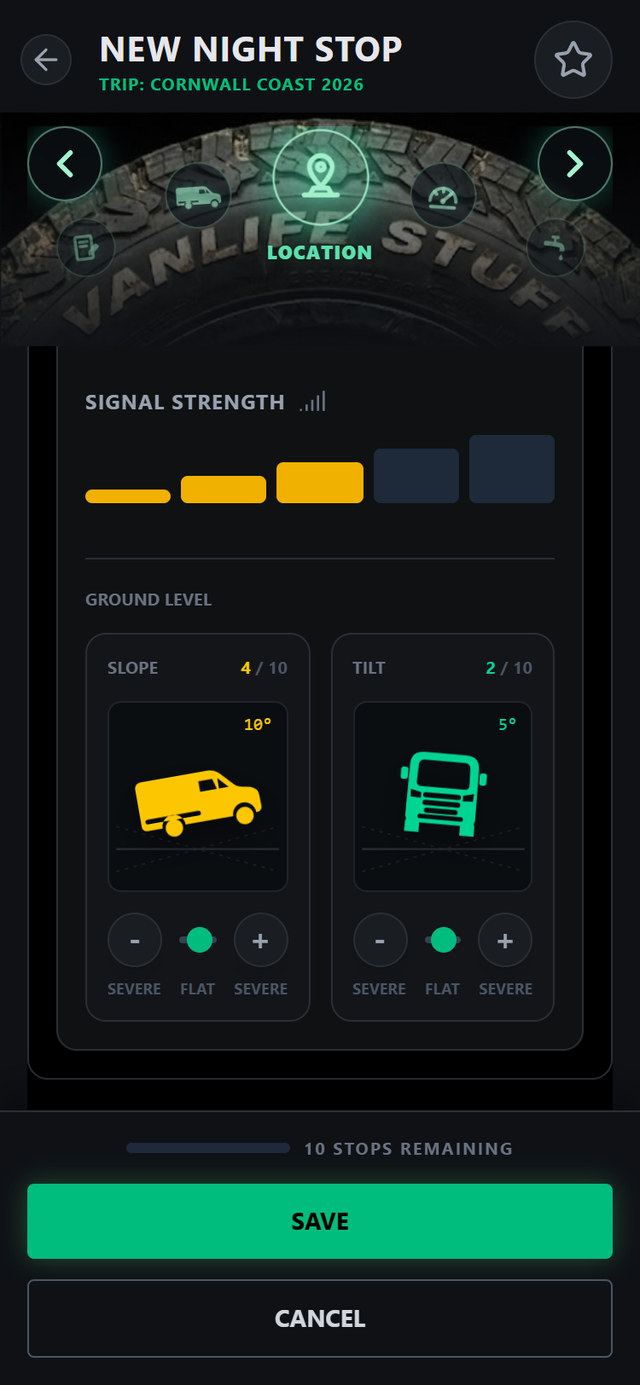
Signal gets its own score
Phone signal is a fact about a place, as fixed as the view and considerably more useful to know in advance. Some trips you want the zero-bar glen. Other times there's a call you can't miss at nine and you need to know the parkup can carry it. Score it once and the question is answered forever. And since the app works with no signal, logging a nought-signal stop works exactly as well as logging a five.
Slope and tilt: how level is it really
Gradient is the score nobody else records and the one your spine cares about most. Stops & Stays logs it two ways: slope, nose-to-tail, and tilt, side-to-side. Each one carries a direction as well as an amount, so the record says nose-up or nose-down, leaning left or leaning right, and not merely how much. Between them they describe the ground you actually slept on rather than the ground the campsite listing promised.
The payoff comes on the return visit. You know before you arrive whether to carry the levelling ramps to the door, which way to orient the van, and which end to point uphill so the blood stays where you left it. A fridge that needs to run level, a door that swings itself shut on a side slope: these problems are all solved by one number written down the first time.
Farm site near Machynlleth, a slope that looks like nothing until you're lying in bed with your feet oddly heavy. The entry from last May says: slope noticeable, nose-down towards the gate, reverse in and it sleeps flat. We reversed in. It slept flat.
Written for future-you
The sliders live in cockpit mode, thumb-sized, no typing, so this is all done from where you are already sitting. The value compounds later. Scroll the history, filter it, and the good stops separate themselves from the ones you tolerated. Patterns show up that memory smooths over: the coastal spots that score high for views and low for sleep, the unpromising pull-ins that turn out to be the quietest nights of the trip.
A parkup review site tells you what a stranger thought on a different night in a different van. Your own scores tell you what you thought, in your van, with your ears. The full record behind every score is on your map and timeline, and the arrival routine that puts the ramps under the low side before anything else is in the first motorhome trip checklist. The ramps and grip mats we carry are on the gear pages.
Rate tonight's parkup before you forget it
Noise, views, signal, slope and tilt, all on sliders. Ten stops free. No ties.