
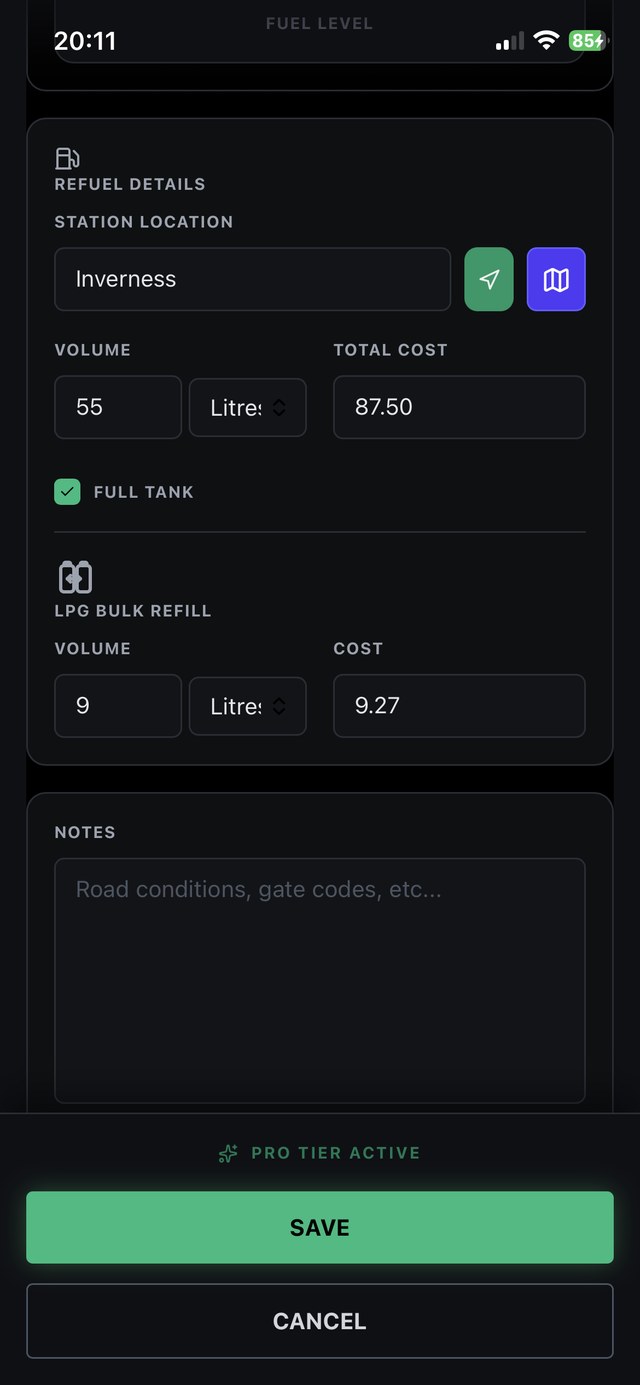
Most people come home from six weeks away with a door pocket full of receipts in three currencies and a rough feeling that it was "about two grand, maybe". The receipts fade, the feeling hardens into fact, and next year's budget is built on it. Logging each cost where it happened replaces the feeling with a number.
Log the money you actually handed over
Costs in Stops & Stays attach to the stop where they happened: the pitch fee, the fill, the toll, the crossing. You record the amount in the currency you paid, exactly as it appeared on the pump or the reader. No converting in your head at a French forecourt while the queue builds behind you. The receipt says 87 euros, you log 87 euros, done.
Ten separate things a stop can charge you for
A night away is rarely one payment. Stops & Stays keeps ten cost lines apart rather than lumping them into a single figure: site or pitch fees, electric hookup, wifi access, laundry, elsan disposal, fresh water, waste water, rubbish, LPG cylinder exchange and LPG onboard top-up. Fuel, tolls and ferries have their own entries on top.
Splitting them is what makes the totals worth reading. A month where the laundry doubled and the pitch fees stayed flat is a different month from one where the site put its prices up, and one number can never tell you which you had. Full-timers get the most out of this, because for them those ten lines are the household bills.
Per-stop currency, because borders happen
The currency is selectable on each stop, in pounds, euros or dollars, with your home currency as the default. Cross the Channel and back in one driving day and each entry simply carries its own currency. Pounds for the fill before the ferry, euros for the péage and the aire, pounds again off the boat at Hull. The log follows the trip; you never fight a settings screen at a border.
This sounds like a small thing until you've spent a fortnight on the continent, where a week of card taps in a currency you don't think in turns into genuine mystery spending. Logged at the moment of payment, it stays legible.
Self-service pump outside Åndalsnes, unmanned, card only, heavy rain on the canopy. Fill logged before the flap was shut, odometer off the dash while I was sat there anyway. In October, when someone asked what Norway did to the fuel budget, the answer was an actual figure.
Why fuel gets its own log
Fuel is one of the five entry types because it behaves unlike anything else you buy: frequent, variable, and usually the biggest line on the trip. Each fill is logged against the stop, in the local currency, with the odometer alongside, read off the dash while you are sat there. Your vehicle profile already knows its fuel type and whether it thinks in miles or kilometres, so entries stay consistent across the whole trip.
Over time the fills become a record you can interrogate: where diesel was dear, where it was worth the detour, how the van drinks when it's loaded for a month versus a weekend. If the van is electric, the same entries become charges instead, labelled as charging, in the same totals. Electric campers get their own page.
Adding it all up
Day to day, the log is the answer to "what have we spent so far". After the trip, Pro's stats turn the entries into charts: costs over the trip, fuel consumption, the trends you'd never spot in a list. And since each trip is its own container, the France spring tour and the October Highlands run keep their numbers separate instead of blurring into one pile.
Your figures stay yours as well. Pro exports everything as CSV, so if you want to do something spreadsheet-shaped with three years of fills, the data walks out of the app and into your hands. It all logs with no signal too, remote pumps and mid-Channel ferry decks being what they are. For what those numbers look like on a continental run, see what the péage charges a motorhome.
Put the next fill in the book
Fill-ups and fees recorded in the currency you actually paid. Ten stops free. No ties.