
The overnight parkup is only part of what a trip costs, and only part of what's worth remembering. There's the diesel, the péage tickets accumulating in the door pocket, the water and waste stops, the ferry that got you over the water in the first place. Stops & Stays logs all of it as five distinct entry types, so nothing ends up scribbled on a receipt that dissolves in a wet jacket.
Stops: the overnights
A Stop is anywhere you sleep: a wild spot above a sea loch, a campsite with the full works, and the types in between. These are the entries that earn the detail: scores for noise, views and signal, weather, facilities, notes, and arrival and departure levels for your tanks. Six months on, this is the entry that tells you whether that layby near Applecross deserves a second visit.
Services: the unglamorous essentials
Nobody romanticises emptying a toilet cassette, but you still need to know where you did it and when. A Service entry covers the facilities visit: water fill, waste dump, the practical pit stop that keeps the van habitable. Logging these builds a private record of which service points were worth the detour and how long you go between fills.
Fuel and tolls: the drip-feed costs
Fuel entries record the fills that dominate a trip's budget, and they feed the wider cost picture, each one logged in whatever currency the pump charged. Tolls get their own type because they behave differently: small, frequent, forgettable. Four péage stops between Calais and Lyon don't feel like much until you add them up in October and discover what the autoroute really cost.
Ferries, including the multi-leg ones
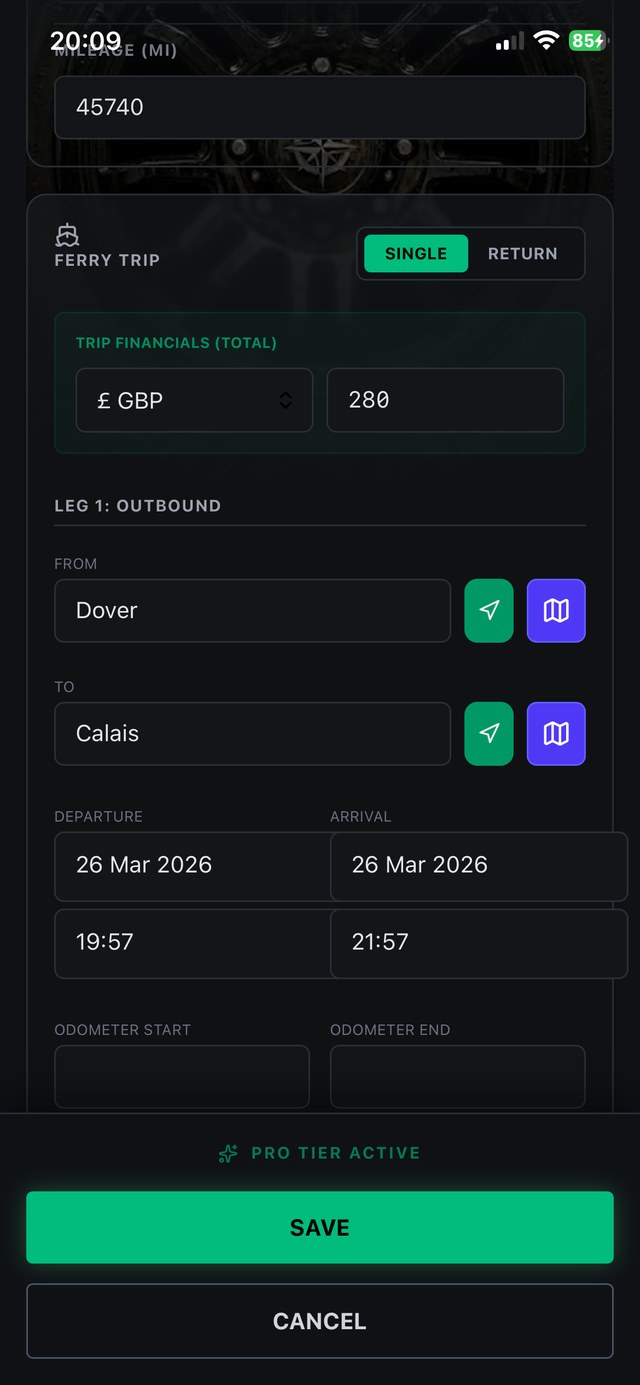
A ferry is not a toll with a sea view. It has legs, timings and a fare structure apparently designed by a committee that never met. So Ferry entries support multi-leg journeys with a total cost: one entry for the whole crossing pattern, however many boats it took. Island-hopping through the Hebrides is one journey with one number attached, not three orphaned records.
Lewis and Harris loop in September: Ullapool to Stornoway out, Tarbert to Uig coming home. Logged as a single ferry entry, two legs, total cost in one place. When someone at the campsite asked what the crossings had come to, the answer was one entry and no rummaging through the glovebox.
Five types sounds like admin. In practice each entry type only asks for what is relevant to it, so a toll is a handful of fields while a proper overnight stop gets the full treatment. The right amount of detail at the right moment, and all of it lands in one timeline you can filter and edit later.
Every entry lands in a trip
Three weeks through France and a wet weekend in the Peak District are different animals, and they shouldn't share a logbook. Pile every stop into one long list and the list stops meaning anything by August, so each trip is its own container with a name, dates, a status and a colour. Once "Normandy, May" is blue and "Highlands, October" is orange you can tell them apart at a glance anywhere they appear, and a finished tour sits closed in the archive while the current one stays live. The free tier runs one trip; Pro removes the limit, so past tours stay on the shelf alongside the one lying open.
A trip records its own start and end too: odometer readings, locations, and initial and final levels across your tanks and batteries. Those bookends are what make the whole record add up, giving you the real distance and the real gas figure for the fortnight rather than the route planner's estimate from before the detours.
A default vehicle per trip
If you run more than one vehicle (the motorhome for the long hauls, something smaller for weekends), each trip takes a default vehicle from your profiles. Every entry then inherits the right context: the right fuel type, miles or kilometres as that vehicle thinks of them, and only the systems that van carries showing up in the app. The van and the trip belong to each other, the way they do in real life.
One control switches the lot
Moving between trips is the selector on the dashboard. Pick a trip and the app's context follows: the stops you see, the timeline you scroll, the totals you're adding to. New entries land in the trip you've selected, so logging tonight's parkup never contaminates last year's tour. Flick back to an old one and it is all there as you left it: every stop, every fill, the costs in whatever currencies you paid them, the levels, the scores.
If there is no trip to end
A trip does not have to be a holiday. Nothing in the app insists on an end date, so people living in the van keep one open and let the stops accumulate. They no longer have to think about it either way: the monthly and date-range reports total every stop in a period across all your trips at once, so February comes out as February whichever trip those stops sat in. How full-timers use it.
Everything above works with no signal, because tolls and ferry terminals are not famous for their 4G. One trip, one logbook, no gaps. If the crossings and the péage are what you are costing up, the guide to what the péage charges a motorhome has the figures.
Every ferry, toll and fill in the right trip
Five entry types cover everything the road charges you, and each one knows which journey it belongs to. Ten stops free. No ties.